
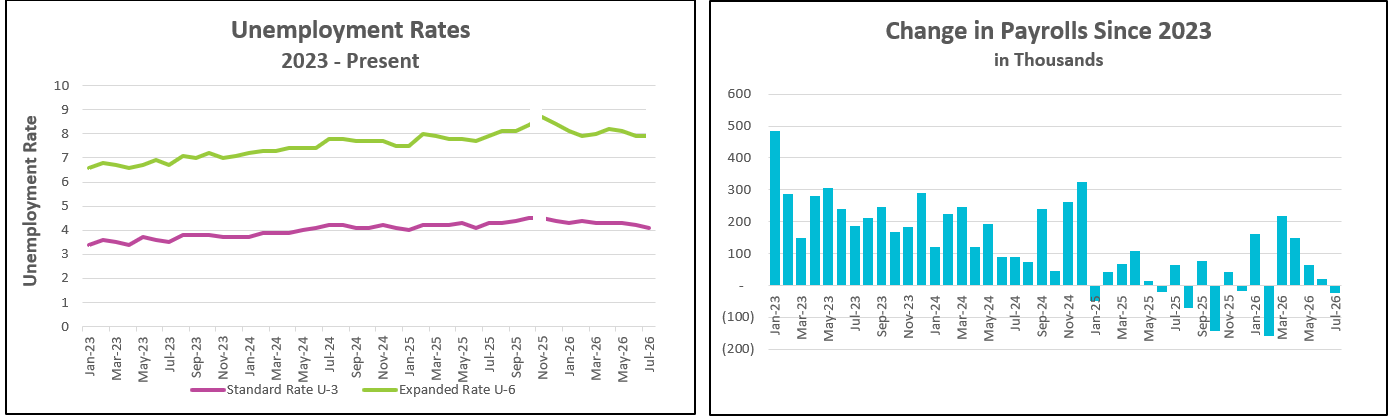
Key takeaways from the Bureau of Labor Statistics (BLS) report, The Employment Situation – July 2026, include:
The July employment report presents a mixed picture of the U.S. labor market, but overall, it was discouraging. On the surface, the unemployment rate improved slightly, falling to 4.1%. But the decline is misleading. Fewer people were employed in July, and the unemployment rate fell primarily because even more people stopped looking for work. When people are no longer seeking employment, they are no longer counted as unemployed.
The labor force shrank by 264,000 people in July, pushing the labor force participation rate down from 61.5% to 61.4%. That is the lowest participation rate since February 2021 and nearly one percentage point below its level a year ago. The continuing decline in participation is an important warning sign because it means a smaller share of the population is either working or actively looking for work.
Employers added fewer workers to payrolls in July, while the Bureau of Labor Statistics also significantly lowered its estimates for May and June. Private-sector payrolls increased by only 30,000 workers, well below the average monthly increase of about 61,000 jobs since the beginning of the year.
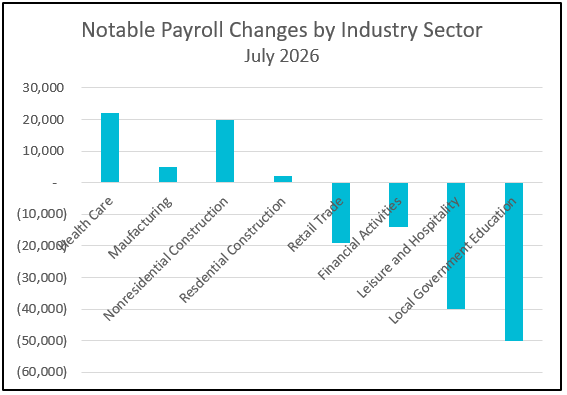
The largest decline in employment came from local governments, particularly in education. This may be partly a statistical quirk because many teachers’ contracts end during the summer and are renewed when the new school year begins. Private educational institutions, in contrast, added 2,800 workers in July.
Other industries experienced employment declines as well, including leisure and entertainment, retail, and financial services. The decline in financial services may reflect, at least in part, the growing use of artificial intelligence and other technologies that allow companies to accomplish more with fewer employees.
The end of the World Cup may also be affecting the employment numbers. Hotels, restaurants, and bars hired temporary workers earlier in the year in anticipation of increased demand from the tournament. With the World Cup ending on July 19, some of those temporary positions are no longer needed.
The July report provides some evidence that aggregate demand—the overall demand for goods and services in the economy—may be weakening. This is occurring despite an increase in consumer spending reported by the Bureau of Economic Analysis for June. Tax refunds helped support consumer spending earlier in the year. Inflation subsided as hostilities in the war with Iran subsided. Businesses adapted to the tariffs. But the environment has changed since June. The war has resumed, and a new round of tariffs has been introduced. These developments could further restrain consumer and business spending in the months ahead.
When businesses face uncertainty about future sales and costs, they have less incentive to hire. The combination of inflation, tariffs, geopolitical uncertainty, immigration restrictions, and rapid advances in artificial intelligence may therefore be contributing to weaker demand for labor.
Not every part of the economy is weakening. Health care continues to add jobs, although hiring has slowed considerably. Health-care employment increased by 22,000 in July, compared with an average monthly gain of 36,000 over the past year.
Manufacturing, construction, and professional services also added workers. Much of the strength in construction appears to stem from the enormous investment in artificial intelligence infrastructure and facilities. Residential construction, however, remained flat in July and has lost approximately 14,000 jobs over the past year.
Another concern is the slowdown in wage growth. Average wages were essentially flat in July and have increased just 3.2% over the past 12 months. That is the slowest annual wage growth in five years.
Earlier in the year, wage gains were exceeding inflation, providing some relief to households. More recently, however, wage growth has decelerated, suggesting that workers may once again be losing purchasing power if inflation outpaces wage growth.
The July inflation report, which will be released next week, will provide an important piece of the puzzle. If inflation remains elevated while wage growth continues to slow, households could face increasing financial pressure.
The July employment report increases the probability that the Federal Reserve will leave interest rates unchanged when policymakers meet in September.
The Fed has a dual mandate: to promote maximum employment while maintaining stable prices. For several years, however, inflation has remained above the Fed's 2% target. That has caused policymakers to place greater emphasis on controlling inflation, even at the risk of weakening the labor market.
At the Fed's most recent meeting, three Governors voted to raise interest rates. They were encouraged by what they viewed as a relatively strong labor market and were concerned that inflation remained too high.
The July employment report could change that assessment. A weakening labor market makes additional rate increases more difficult to justify, particularly if the economy is losing momentum. At the same time, inflation remains above the Fed's target, limiting its ability to respond aggressively to a slowing economy.
This is the worst combination for monetary policymakers: a weakening labor market accompanied by elevated inflation.
If inflation were falling rapidly, the Fed could lower interest rates to support employment. If employment were strong and inflation were rising, it could raise rates to contain price pressures. But when employment is weakening while inflation remains elevated, the Fed's two objectives work against each other.
The September decision is therefore far from certain. Before policymakers meet, they will receive another employment report and additional inflation data, including the August employment report and the July and August CPI reports. Those numbers will be critical in determining whether the July slowdown represents the beginning of a more significant deterioration in the labor market or simply another month of unusually weak hiring.
For now, the July report suggests that the labor market is losing momentum. The decline in unemployment provides little comfort because it was driven by people leaving the labor force rather than by stronger employment. With hiring slowing, wage growth moderating, and economic uncertainty increasing, the report raises new questions about the strength of the U.S. economy heading into the second half of the year.