The Bureau of Economic Analysis published key July statistics in its Personal Income and Outlays report. Here are the key highlights.
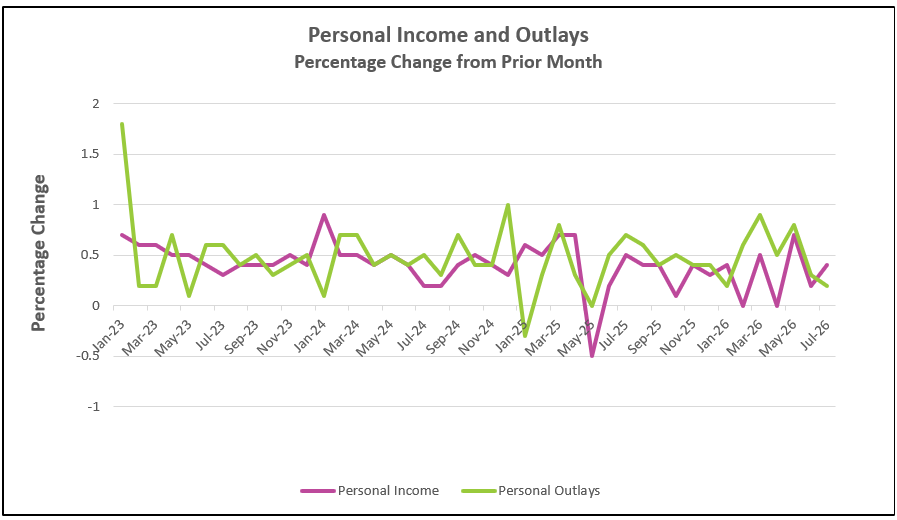
Consumers tapped the brakes in July, offering one of the clearest signs yet that household budgets are feeling the strain of months where wages failed to keep pace with rising prices. After a spring defined by resilient spending, July marked a turning point: real consumer spending was flat, and households shifted their dollars away from goods and toward services.
This slowdown came even as disposable income finally outpaced inflation, a welcome change after several months of erosion in purchasing power. But the improvement wasn’t enough to spark stronger spending, suggesting consumers are becoming more cautious as economic uncertainty grows.
Inflation offered a similarly conflicted message. The good news: inflation did not increase on a 12‑month basis. The bad news: it didn’t decelerate either. The 12‑month PCE index held steady at 3.7%, and the core PCE index—excluding food and energy—remained at 3.3%.
Both measures are well above the Federal Reserve’s 2% target, and both have now hovered at elevated levels for more than five years.
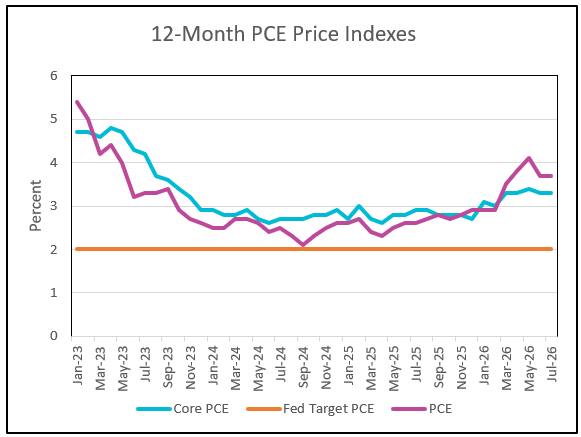
On a monthly basis, inflation ticked up slightly, reversing part of June’s 0.1% decline. That small bump matters: it reinforces the idea that inflation is sticky, not sliding smoothly back toward target.
Consumers Are Feeling It: Real Wages Slip Again
Consumers are increasingly feeling the strain of persistent inflation and weakening purchasing power. According to the Bureau of Labor Statistics, real average hourly earnings are now $0.02 lower than a year ago (BLS Real Wages), a small but meaningful decline that, combined with rising gas prices, further reduces the income available for other purchases. July’s data reinforces this pressure: inflation‑adjusted consumer spending was flat, and households continued to shift away from goods toward services, a pattern consistent with tighter budgets. Even though disposable income finally grew faster than inflation in July, consumers appear hesitant to spend, signaling caution after months in which wages failed to keep pace with rising prices. These behaviors—cutting back on goods, slowing overall spending, and reacting to higher essential costs—underscore a consumer sector losing momentum and growing more sensitive to economic uncertainty.
Inflation remains stubborn because several powerful forces are pushing prices higher simultaneously. Oil supply disruptions—driven by the US and Israel’s conflict with Iran and restricted shipping through the Strait of Hormuz—have raised energy costs globally. Tariffs imposed by President Trump, beginning in April 2025 and expanded recently to include new duties on Canada, have further increased prices on imported goods. At the same time, the rapid expansion of AI has triggered a surge in demand for chips, software, and advanced computing equipment, driving up costs for both components and the products that rely on them. These pressures pushed the PCE price index from 2.9% in February to 4.1% in May, before it eased slightly. Inflation had previously fallen from its 7% peak in June 2022 to 2.6% when President Trump took office, but the combination of geopolitical conflict, supply constraints, and tariff‑driven price increases has kept inflation elevated and prevented the steady deceleration policymakers have been hoping for.
The Federal Reserve faces one of its most complicated policy decisions in years as it weighs persistent inflation against signs of a slowing economy. Inflation remains above the Fed’s 2% target, yet it has been gradually easing, creating tension between policymakers who want to hold rates steady and those who believe stronger action is overdue. Consumers are clearly feeling the strain: real average hourly earnings are now $0.02 lower than a year ago, gas prices have reduced discretionary income, and households are beginning to cut back on spending. These developments strengthen the argument for leaving the benchmark rate unchanged to avoid tightening into weakness. But others on the Federal Open Market Committee are growing impatient, noting that inflation has exceeded the Fed’s target for more than five years and that new pressures—tariffs, oil disruptions, and surging demand for AI‑related chips and computing equipment—continue to push prices higher. Fed Chairman Kevin Warsh, speaking in Jackson Hole, underscored that inflation remains the central concern, highlighting the delicate balance the Fed must strike as it navigates slowing consumer momentum and stubborn price pressures.
Looking ahead, June’s Employment Situation report, set for release on September 4, will be closely monitored—particularly regarding the labor market’s strength, and whether hourly wage growth outpaces inflation. Higher Rock will publish a summary and analysis shortly after the report is released. Stay tuned.