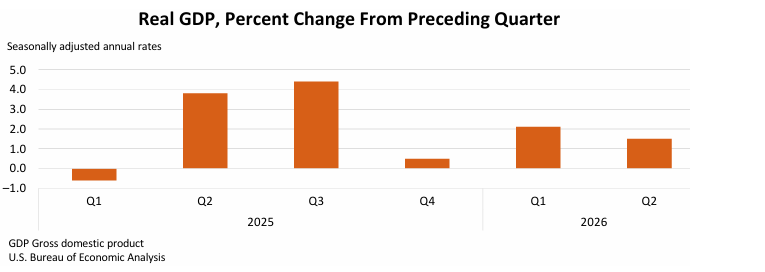
The Bureau of Economic Analysis Gross Domestic Product, 2nd Quarter 2026 (Advance Estimate), painted a mixed picture of the US economy during the second quarter. Its key takeaways include:
Consumer Spending Keeps the Economy Growing Despite Slower GDP and Rising Inflation
Real Gross Domestic Product (RGDP)—the broadest measure of economic activity—grew at an annual rate of 1.5% during the second quarter, down from 2.1% in the first quarter. While the headline number suggests the economy lost momentum, the slowdown largely reflected temporary factors rather than weakening private demand. A surge in imports, lower government spending, and reduced business inventories accounted for most of the deceleration, while the economy's most stable components remained remarkably resilient.
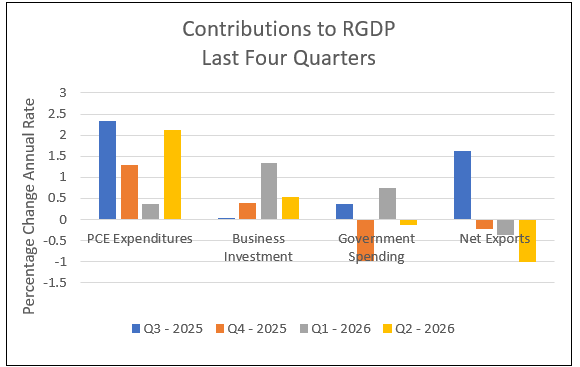
One of the strongest indicators of underlying economic health was final sales to private domestic purchasers, which rose 3.9% during the quarter—the fastest pace in three years. Economists and Federal Reserve policymakers closely monitor this measure because it excludes volatile components such as trade flows, inventory adjustments, and government spending. As a result, it provides a clearer picture of private-sector demand and inflationary pressures. The sharp increase suggests the underlying economy may be strengthening despite slower headline GDP growth. The graph below illustrates the contributions of each component to gross domestic product.
Consumer Spending
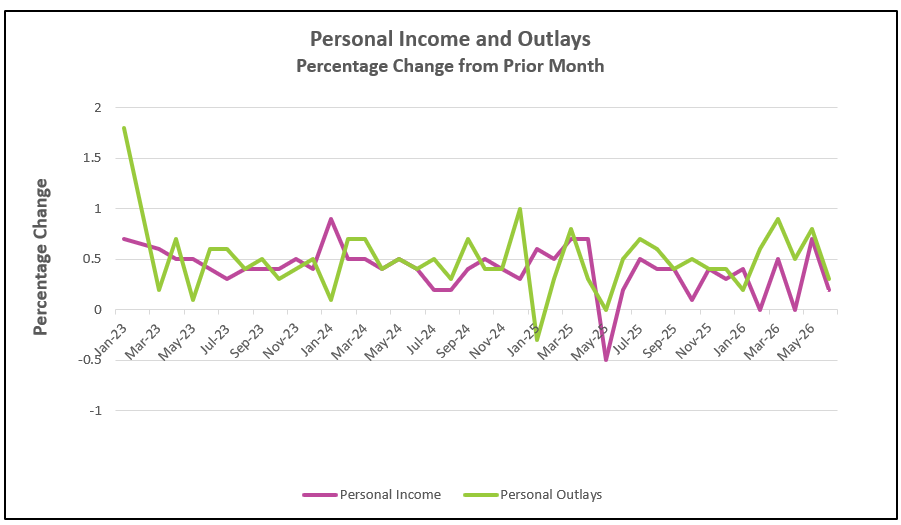
Consumers once again carried much of the economy despite higher prices and considerable uncertainty surrounding tariffs, renewed tensions with Iran, and the upcoming mid-term elections. However, much of that momentum occurred earlier in the quarter, as growth in both personal income and consumer spending moderated in June. Consumer spending increased at an annual rate of 3.2% during the second quarter, its strongest gain since the third quarter of 2025. That is despite a deceleration in June. Large tax refunds and lower gasoline prices toward the end of the quarter provided additional support for household budgets. Spending also benefited from the FIFA World Cup, which boosted recreational sports purchases by 23.4%. (BEA Personal Income and Outlays - June 2026)
Business Investment Continues to Benefit from the AI Boom
Businesses also remained confident. Although business investment slowed from the more than 10% pace recorded during the first quarter, it still increased at a robust annual rate of 8.4%, contributing more than one-half percentage point to overall economic growth. Continued investment in artificial intelligence infrastructure remained a key driver.
The AI investment boom, however, does not translate dollar-for-dollar into GDP growth. Investments in domestic construction, engineering, software development, electrical infrastructure, and equipment installation directly increase GDP because they represent production within the United States. By contrast, imported semiconductors, computer chips, servers, and other foreign-made technology equipment are subtracted from GDP because they are produced overseas. As a result, the economic contribution of AI investment is significant but smaller than the headline spending announcements made by technology companies.
Inventory Drawdowns and Imports Weigh on GDP
An inventory drawdown reduced the business contribution, subtracting 0.67 percentage points from RGDP growth. This does not necessarily indicate weak sales. Instead, companies sold goods that had been produced in earlier quarters rather than producing as many new goods during the current quarter. Because GDP measures current production, inventory drawdowns reduce measured economic growth even when customer demand remains healthy.
International trade also weighed heavily on GDP.
Net exports declined as imports surged, reducing second-quarter growth by approximately 1.5 percentage points. Exports add to GDP because they are produced domestically, while imports are subtracted because they are produced abroad. Large capital investments also increased demand for imported machinery, technology equipment, and industrial supplies.
Government Spending Declines Due to Strategic Petroleum Reserve Sales
Government spending also slowed during the quarter. Much of the decline reflects sales from the Strategic Petroleum Reserve. These transactions do not increase GDP because they involve selling an existing government-owned asset rather than producing new goods or services. GDP measures current production, not transfers of previously produced assets.
Inflation Accelerates Despite June Relief
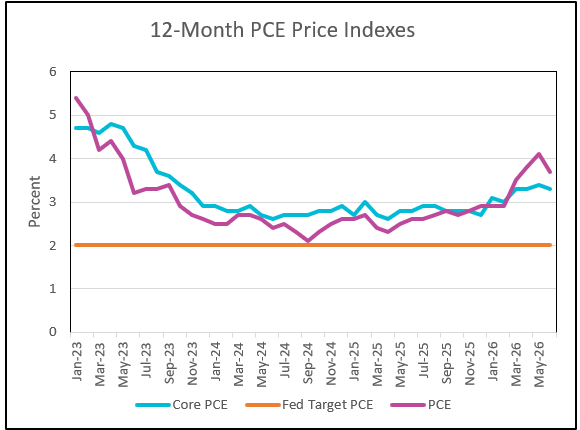
While economic growth moderated, inflation accelerated in the second quarter, with the Personal Consumption Expenditures (PCE) Price Index rising at an annualized rate of 5.1%. When measured over the prior 12 months, prices are up 3.7%. Because second-quarter inflation exceeded the 12-month rate, the data indicate that inflation has recently accelerated rather than continued to cool, despite a drop in prices in June, when the monthly PCE Price Index declined 0.1%, marking the first monthly decrease since April 2020 after several consecutive increases, including a sharp 0.5% rise in May. The decline largely reflected lower oil prices following the reopening of the Strait of Hormuz. Nevertheless, renewed tensions between the United States and Iran quickly disrupted shipping once again, raising concerns that energy prices could rebound. Despite June's improvement, inflation remains well above the Federal Reserve's 2.0% objective.
Core Inflation Shows Improvement
Underlying inflation trends were somewhat more favorable. Excluding the volatile food and energy categories, the core PCE Price Index increased at an annualized rate of 3.4% during the second quarter, down from 4.4% in the first quarter. On a 12-month basis, core inflation measured 3.3%, a slight improvement from May, suggesting that underlying price pressures are easing gradually even though overall inflation remains elevated.
Federal Reserve Remains on Hold
Given these mixed signals, Federal Reserve policymakers left interest rates unchanged at their most recent meeting. However, the decision was far from unanimous, with three governors voting in favor of increasing the benchmark interest rate to combat accelerating inflation. Although June's decline in monthly prices was encouraging, inflation remains well above the Fed's target, and recent quarterly data suggest price pressures have intensified. For now, policymakers appear willing to wait for additional evidence before determining whether inflation is once again moving toward their long-term objective or whether further monetary tightening will ultimately be necessary.
Overall, the second-quarter economy was considerably stronger than the headline GDP figure suggests. Consumers continued spending, businesses maintained solid investment—particularly in AI—and private domestic demand posted its strongest performance in three years. At the same time, higher inflation and geopolitical uncertainty continue to cloud the outlook. Whether the economy can sustain its momentum without reigniting inflation will remain the central question facing households, businesses, investors, and Federal Reserve policymakers during the second half of the year. The Bureau of Labor Statistics will release its Employment Summary for July on Friday. Higher Rock will publish its summary and analytical blog shortly after its release.