
Key takeaways from the Bureau of Labor Statistics (BLS) report, The Employment Situation – May 2026, include:
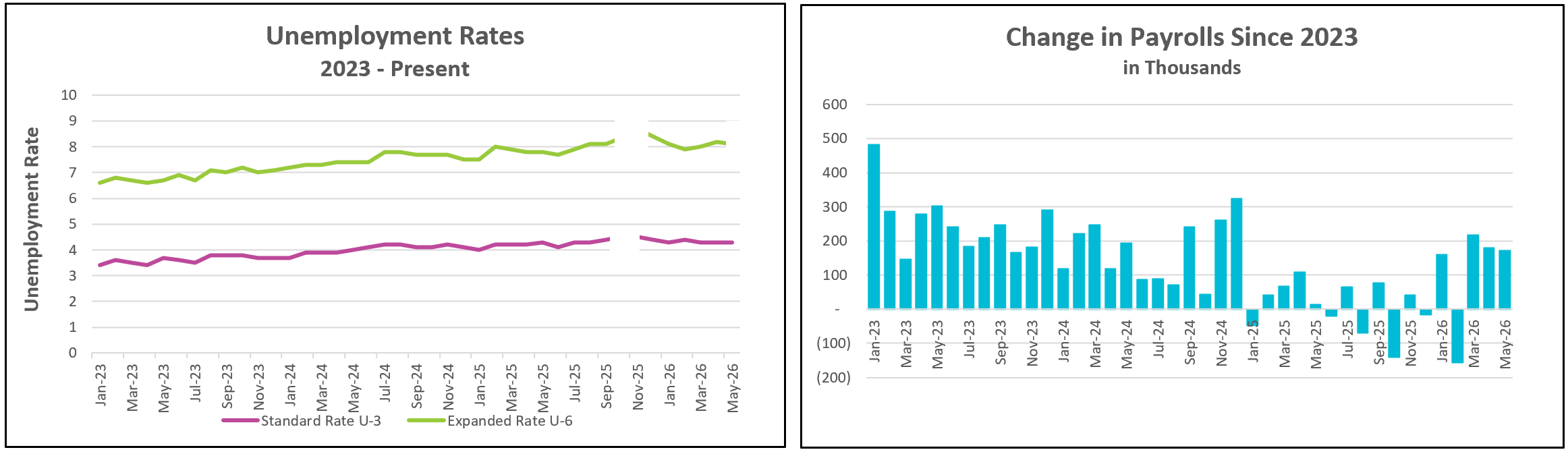
The U.S. labor market continued its surprising resurgence in May, extending a streak of robust hiring that few economists would have predicted just a year ago. Payrolls increased by more than 150,000 people for the third consecutive month, suggesting that the labor market has largely emerged from the sluggish conditions that characterized much of 2025. The recent hiring gains have occurred despite a long list of headwinds, including the war with Iran, rising inflation, tariffs, concerns about artificial intelligence, and a deeply polarized political environment.
Adding to the positive news, employment figures for March and April were revised higher, indicating that labor market conditions were stronger than previously reported. While the unemployment rate remained unchanged in May, the underlying details were encouraging. The labor force expanded by 83,000 people, while the number of Americans employed increased by 149,000.
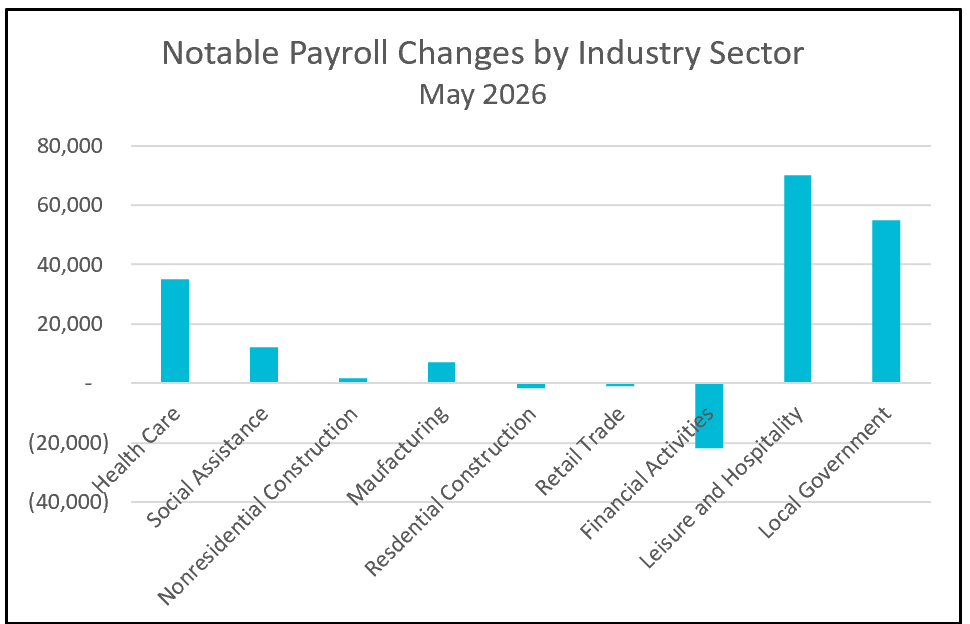
Leisure and hospitality led the hiring surge, adding 70,000 jobs and accounting for more than 40 percent of all payroll gains. Much of the increase appears tied to preparations for the upcoming FIFA World Cup, which is expected to generate billions of dollars in economic activity across the United States, Canada, and Mexico. The tournament will feature 104 matches across 16 stadiums, involving 48 teams, and is already boosting demand for workers in hotels, restaurants, entertainment venues, and related industries. May’s increase in leisure and hospitality employment was the largest in three years.
Government employment also played a significant role in supporting overall job growth. Local governments added 55,000 workers during the month, helping strengthen payroll gains nationwide. Meanwhile, health care employment increased by 35,200 jobs, and social assistance payrolls expanded by 12,000 workers. The continued growth in these sectors reflects the demographic reality of an aging population that requires more medical care, caregiving services, and social support programs.
Other sectors also hired. Employment in mining and oil and gas extraction rose by 5,000 jobs, extending a recent period of expansion. Nonresidential construction also continued to benefit from the artificial intelligence boom as major technology firms invest billions of dollars in new AI data centers. Companies such as Google, Microsoft, Amazon, and Meta are driving significant demand for construction workers, engineers, and skilled trades as they expand computing capacity to support AI development.
Not all industries shared in the gains. Employment in financial services fell by 22,000 jobs in May and is now down 107,000 from a year ago. Air transportation shed 8,700 jobs following Spirit Airlines’ shutdown. Residential construction also remained weak, with employment continuing to decline and remaining below year-earlier levels as higher borrowing costs weigh on housing demand.
While employment growth remains healthy, wage gains are failing to keep pace with rising prices. Average hourly earnings increased 3.6 percent over the past year, the slowest pace of wage growth since 2021. Prices rose 3.8% in April. Because inflation is rising faster than wages, many households are experiencing a decline in purchasing power and are being forced to reduce discretionary spending. This erosion in real income is increasingly evident in consumer sentiment measures.
The policy outlook has become more complicated following the arrival of Kevin Warsh as Chairperson of the Federal Reserve. Warsh has indicated a willingness to lower interest rates, but many policymakers remain concerned that inflation is still too high to justify easing monetary policy. The disagreement reflects a difficult reality: inflation remains above the Federal Reserve’s target while the labor market continues to generate strong job growth. Under those conditions, many economists worry that lowering interest rates could stimulate demand further and make inflation even harder to control.
Warsh will face his first major test during the Federal Reserve’s June 16-17 policy meeting. His challenge will be balancing pressure from President Trump, who has advocated lower interest rates, with the concerns of investors and economists who want to see inflation brought under control before monetary policy is loosened.
For now, the broader economy continues to receive support from other sources. Large tax refunds have helped sustain consumer spending, while a recent Supreme Court ruling requires the federal government to refund some tariffs previously paid by businesses. Those refunds could encourage additional business investment and provide a temporary boost to economic activity.
Nevertheless, significant risks remain. Persistent inflation poses the greatest threat to continued economic expansion. When prices rise faster than wages, households lose purchasing power and often cut spending. Reduced consumer spending lowers demand for goods and services, which can ultimately lead businesses to reduce hiring or cut payrolls. If inflation also triggers a stock market selloff, declining household wealth could further weaken consumer confidence and spending, particularly among higher-income households.
The rapid advancement of artificial intelligence presents another challenge. While AI-related investment is creating jobs in construction and technology infrastructure today, the technology could eventually reduce labor demand in a variety of occupations, slowing hiring growth in future years.
Deteriorating consumer attitudes already reflect growing concern. Consumer sentiment declined (Michigan Consumer Sentiment Index) for the third consecutive month, reaching its lowest level in years as Americans increasingly worry about inflation and their financial outlook. Pessimism is most pronounced among lower-income households, whose real earnings have fallen. However, sentiment has also deteriorated among Republicans and higher-income consumers, suggesting that economic concerns are broadening beyond traditionally vulnerable groups.
The labor market’s recent strength demonstrates that the U.S. economy remains remarkably resilient. However, beneath the encouraging employment figures lies a more complicated story. Strong hiring, slowing wage growth, persistent inflation, and growing consumer anxiety suggest that policymakers may soon face difficult choices. Whether the economy can maintain its momentum without reigniting inflation will be one of the defining questions for the remainder of 2026.
Policymakers will closely monitor May’s Consumer Price Index (CPI), which is scheduled for release on Wednesday, just days before the Federal Reserve’s next policy meeting. Higher Rock will publish a detailed analysis and summary shortly after the report is released.