The inflation figures from the Bureau of Labor Statistics (BLS) Press Release: Consumer Price Index (CPI) – June 2026.
For many American households, June brought a rare piece of good economic news: prices eased across a broad range of essential goods and services, giving consumers a much-needed break after months of persistent inflation.
The latest inflation data showed that wage growth finally outpaced rising prices, providing families with greater purchasing power. At the same time, several key household expenses—including gasoline, electricity, auto insurance, medical care, and clothing—declined during the month. Housing costs also showed encouraging signs of moderation, with the shelter index recording its smallest increase since January 2021. The good news raised Michigan’s Consumer Sentiment Index by about 10%.
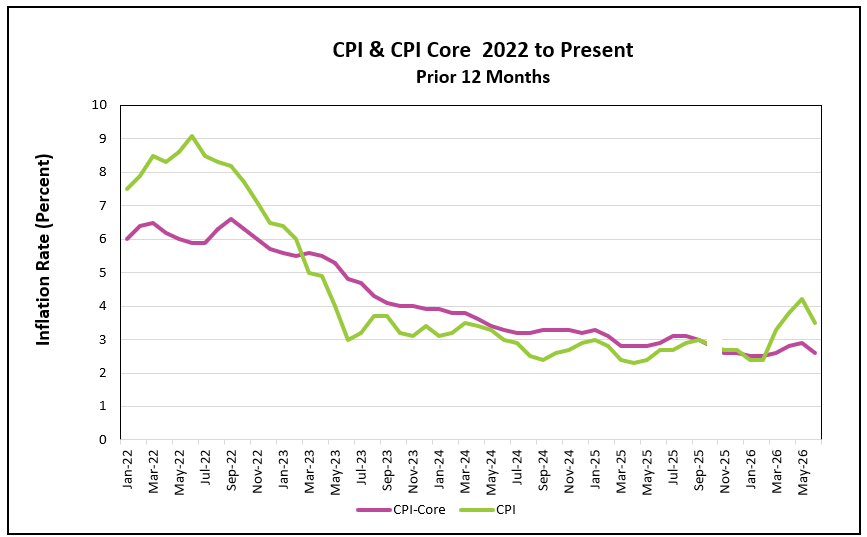
The Consumer Price Index (CPI) fell 0.4% in June, marking the first monthly decline since March 2025 and the largest monthly decline in more than six years. On a year-over-year basis, inflation slowed to 3.5%, down from 4.2% in May.
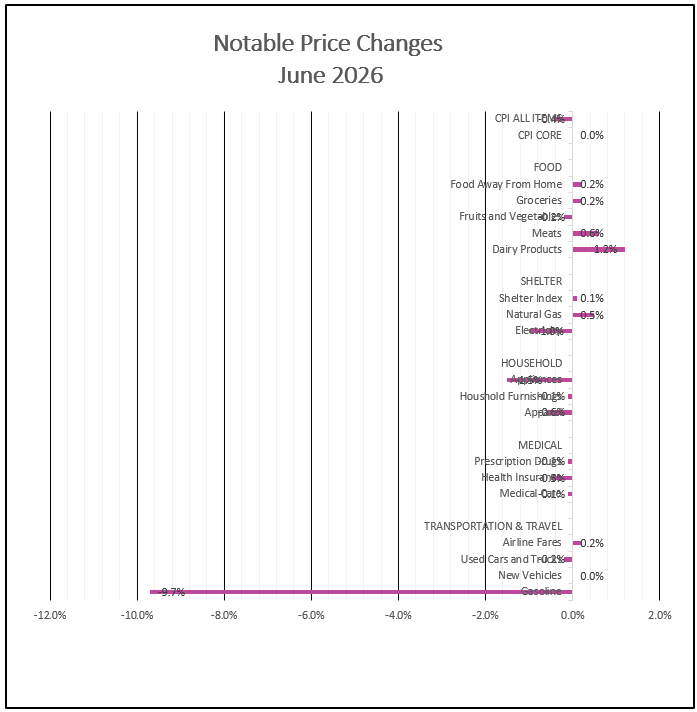
A major factor behind the decline was the sharp drop in gasoline prices. Gasoline costs fell 9.7% during June following the reopening of the Strait of Hormuz and an agreement that temporarily ended hostilities involving Iran. Even so, gasoline prices remain nearly 27% higher than they were a year ago. With tensions in the region having resumed and oil prices rising again, consumers may find that this source of relief proves short-lived.
Encouragingly, inflation pressures eased beyond energy costs. The core inflation index, which excludes volatile food and energy prices and is often viewed as a better measure of underlying inflation trends, also moderated. The monthly core index was unchanged—the lowest reading since January 2021—while annual core inflation slowed to 2.6% from 2.9% in May.
Despite the positive headline numbers, some areas continue to place pressure on household budgets. Food prices remained elevated in June, particularly for meats and dairy products, which increased 0.6% and 1.2%, respectively. Rising fertilizer costs are expected to place additional upward pressure on food prices in the months ahead.
Electricity prices provided some relief during June, but longer-term trends remain concerning. Growing demand for power, driven in part by the rapid expansion of data centers and artificial intelligence technologies, is expected to place upward pressure on utility costs over time.
Technology-related expenses are also emerging as an inflation concern. As businesses and consumers increasingly adopt artificial intelligence tools, demand for chips, computing equipment, and software continues to grow. Computer software prices increased 2.3% in June and are 17.4% higher than a year ago.
Questions also remain about whether inflation pressures have truly subsided or are merely being masked by temporary declines in energy prices. Rising technology costs, ongoing geopolitical uncertainty, and the continued impact of tariffs could all contribute to renewed price pressures in the months ahead.
The June inflation report gives Federal Reserve policymakers reasons for cautious optimism, but it is unlikely to be enough on its own to signal victory over inflation. The broad-based moderation in prices, combined with slower core inflation, suggests that previous monetary policy actions may be having their intended effect. As a result, the Fed is less likely to raise interest rates further in the near term.
However, policymakers will likely remain cautious. Much of June's improvement was driven by declining energy prices, particularly gasoline. Because energy markets can be highly volatile and are heavily influenced by geopolitical events, Fed officials typically focus more closely on core inflation measures that exclude food and energy prices. While core inflation also improved in June, it remains above the Federal Reserve's long-run target of 2%.
Consequently, the most likely outcome is that the Federal Reserve will maintain a wait-and-see approach. Rather than responding to a single favorable inflation report, officials will look for several months of consistent evidence that inflation is moving sustainably toward the 2% target. Upcoming releases, including the Personal Consumption Expenditures (PCE) Price Index by the Commerce Department—widely regarded as the Fed's preferred inflation gauge—will play an important role in shaping future policy decisions. Higher Rock will provide an analysis and summary shortly after its release on July 30th.
In short, the June report strengthens the case for keeping interest rates unchanged, but it does not yet provide sufficient evidence for policymakers to declare that inflation has been fully contained. The Fed's challenge remains balancing the need to support economic growth while ensuring that inflation does not reaccelerate.